Kevin
The Minds of Billy MilliganKevin is the planner among the personalities sharing Billy Milligan’s body: a twenty-year-old with blond hair and green eyes, a taste for writing, and a small-time criminal’s practical skill at organizing schemes. His trajectory makes planning itself morally unstable. He can turn careful forethought toward crime, but later uses his position to resist the mistreatment of patients; the same personality moves from concealed offender to an acknowledged defender within the inner group.
Identity and Introduction
Kevin is first presented in the catalog of personalities as a young man who likes to write and has already planned the Gray Drug Store robbery. His designation as the planner is not merely a nickname: the narrative repeatedly shows him arranging criminal activity, considering its risks, and attempting to keep himself separate from its consequences.
The first clues to personalities beyond the ten already known come from discrepancies in accounts of the offenses, including references to the name Philip. Gary Schweickart reasons that these details may point to additional personalities. When Dr. David Caul asks Billy Milligan about the possibility, Billy cannot identify the names or explain the activity. Later, when Caul asks about Kevin and others, Billy recognizes that he has heard their names during an argument inside his mind, but says he does not know who they are. His nervousness and inward attention make the discovery less a straightforward introduction than a glimpse of knowledge emerging before he can interpret it.
Ragen explains that the previously concealed personalities have become rebellious and that Kevin wrote a list of them. In his account, Arthur’s control is weakening, and keeping the personalities hidden had functioned as a defense. The revelation therefore changes the inner group’s understanding of itself: Kevin is not simply a criminal name heard from outside but one of the people whose existence had been suppressed.
Emergence with Philip
The narrative dramatizes Kevin’s appearance through a neighborhood dirt-clod fight. While throwing clods with other boys behind a construction pit, he hears a Brooklyn-accented voice giving advice from nearby, although nobody appears to be standing beside him. The voice belongs to Philip. The two identify themselves to each other, and Philip suggests breaking windows at a school. Kevin agrees, and together they break a dozen windows.
Arthur watches and judges the pair to be criminal types who may become a serious problem. This early scene sets up the division between Kevin’s talent for planning and Arthur’s effort to govern the group: the new personalities act on their own initiative, while Arthur observes, assesses, and later seeks to contain them. It also gives Kevin a distinct entrance. He is not revealed through an account of his appearance alone, but through a meeting that immediately becomes an act of property destruction.
Arthur later explains that Kevin and Philip arose as hate was separated from some of Ragen’s more destructive qualities. In Arthur’s account, the aim was to preserve physical strength while making anger more manageable, but the process produced personalities who used weapons to project power and committed unnecessary crimes against property. Arthur calls Kevin and Philip undesirable after their time at Zanesville. This is Arthur’s explanation of their origin and status, not a neutral account that erases Kevin’s later choices or the disputes over who controls the consciousness.
Planning and Criminal Activity
Kevin’s criminal role extends beyond the school windows. After his official discharge from the Ohio Youth Commission on November 16, 1973, he recalls Gordy Kane’s offer at the Zanesville Youth Camp to provide a drug connection. Kevin visits Gordy at a house in the Reynoldsburg area, tells him he is broke, and asks to borrow enough money to make a purchase and begin dealing. Gordy takes him to a local seller, where Kevin buys three hundred and fifty dollars’ worth of marijuana. Gordy estimates that Kevin can sell it for more than a thousand dollars and repay him afterward. The episode shows Kevin treating criminal activity as an organized business venture, with a loan, a supplier, and an expected return.
His later schemes include the roadside-rest offenses. Kevin boasts to Kathy that he has found what he considers a perfect crime, displaying a watch and explaining that he obtained money and credit cards from two men. When Jim and Kathy examine the cards, they find several bearing different names and realize that the discovery could create a serious problem for the family. Kathy insists that this conduct is unlike Billy Milligan, while Jim confronts the practical question of how to help him. The episode gives the crime a domestic consequence: evidence of Kevin’s actions enters the family’s hands, and the people who care about Billy must respond to a danger they do not regard as characteristic of him.
When Arthur later questions the personalities about the Gray Drug Store robbery and other criminal activity, Kevin admits that he planned the store robbery but says that he was not present. He distinguishes arranging the operation from carrying it out and also acknowledges robbing the two men at the roadside rest, which he characterizes as a setup rather than participation in the store robbery. His account is self-protective, but it confirms the central feature of his role: he can organize a crime and then argue that the distinction between planning and presence should shield him from responsibility.
Kevin’s conduct also crosses into situations involving other personalities. During an abduction involving Carrie Dryer, he takes the spot from Adalana after hearing the car’s tires thud over railway tracks. He checks the tires and continues driving when they appear intact. This brief transfer shows how control can shift in the middle of an external event, placing Kevin’s practical attention at the service of an ongoing offense. Later, when Ragen suspects that others have been stealing his time, Arthur questions Kevin, Philip, and Tommy; all three deny doing so. The narrative establishes suspicion and disputed control, but does not resolve Kevin’s responsibility for the missing time.
Power, Rules, and Conflict
Kevin’s emergence troubles Arthur’s internal order. In one dispute, Arthur tells Ragen that he left a gun unsecured and violated the group’s rules. Ragen counters that a weapon was supposed to remain available, out of children’s reach, for protection against an intruder, and objects that Walter had no right to take it. Arthur’s response that the weapon was unsecured shows the rules operating as competing claims about safety and control. Kevin’s criminal partnership with Philip is part of the wider problem: Arthur believes they may use weapons to make others fear them and considers their crimes unnecessary.
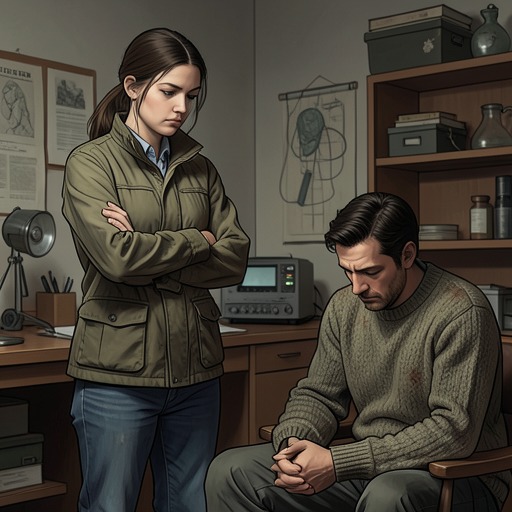
Ragen encounters Kevin directly when, after hearing unfamiliar voices discussing the division of money from a bank robbery, he searches the apartment with his gun and demands silence. The voices stop, but one answers from within the shared consciousness. When Arthur asks what happened, Ragen says he had been arguing with Kevin. The exchange reveals that Kevin can be present to another personality as an interlocutor, while Ragen does not initially know who Kevin is. Their conflict is therefore not only about crime or weapons; it also concerns recognition, access, and who has authority over the shared body.
Arthur later emphasizes that the periods of confused switching make governance difficult. He says that Kevin, Philip, and other undesirable personalities had stolen time in prison, sometimes without Ragen realizing until afterward, and warns that renewed contact with their old criminal associates could violate parole. Kevin’s activities consequently threaten more than the immediate targets of a scheme: they risk exposing the shared person to legal consequences and destabilizing the rules intended to keep outside life manageable.
Change and Later Role
Kevin’s standing changes during a later period in hospital. Billy reports that attendants harassed and beat patients, and that, apart from Ragen, Kevin was the only personality who stood up to them. Arthur recognizes this conduct by removing Kevin from the list of undesirables. The change is significant because it does not erase the earlier crimes or prove that Kevin has abandoned them; rather, it alters how the inner group classifies him after he uses his capacity for action in defense of patients.
In a letter dated March 28, 1980, Kevin describes a worsening situation. He fears that complete unfusion is approaching and that Billy may go to sleep for good. He reports that Billy is weakening in the institution, and that authority figures’ hostility and the patients’ behavior have made the place difficult to endure. Kevin’s language shifts between an individual voice and a collective one, describing the group as rejected and misplaced. That movement reflects his position within the shared identity: he writes as Kevin, yet the crisis he records belongs to all of them.
Kevin also reports that Ragen has stopped the hearing and is turning attention inward to enforce a total block. He presents withdrawal from the outside world as a way to prevent harm, while acknowledging the cost: a world without pain would also be a world without feeling. The letter does not resolve what will happen to Billy or the group. Instead, it leaves Kevin watching for a feared loss of consciousness and describing an inward retreat as both protection and deprivation.
Narrative Role
Kevin brings the concealed personalities’ criminal history into direct conflict with the group’s internal rules and with the family’s efforts to protect Billy. His planning makes the offenses more than impulsive eruptions: he can recruit a partner, arrange a purchase, organize a robbery, and attempt to distinguish preparation from execution. Yet the story also complicates Arthur’s category of the undesirable. Kevin’s later intervention on behalf of patients changes his status, showing that the inner group’s judgments respond to conduct as well as origin.
His appearances repeatedly expose the instability of control. Billy hears names he cannot place; Ragen discovers an argument already under way; Adalana yields the spot during an external event; and the letter presents Kevin’s individual account as inseparable from a threatened collective silence. Kevin is therefore both an agent within the plot and evidence of the group’s contested structure: he can plan actions, conceal himself among other identities, and later speak from a shared crisis whose outcome remains uncertain.